
The essential difference between lead-free crystal glasses and ordinary glass glasses: material composition determines everything
The most common pitfall buyers fall into when comparing prices is treating "crystal glass" as one material grade and "glass cup" as another material grade, then sorting by price. In reality, the differences among these three types of glasses stem first from their compositional systems, and composition directly determines the clarity, clinking sound, and safety that will be discussed later. Once the composition is explained clearly, the subsequent trade-offs will have a basis.
Where do lead-free crystal, leaded crystal, and ordinary glass differ in composition?
Ordinary glass cupsare mainly composed of silicon dioxide, combined with fluxing ingredients such as soda ash and limestone, belonging to the soda-lime glass system. Its composition does not intentionally introduce lead, nor does it introduce components such as barium oxide or zinc oxide that can significantly increase the refractive index, so it is easy to form and low in cost, but its refractive index is relatively low, and the cup wall will show a slight gray-green or gray-blue tint, especially noticeable in thick-walled pieces.
Lead crystalis made by adding a relatively high proportion of lead oxide to the glass formula (in traditional processes, the commonly seen level is around 24%). The role of lead is to increase the refractive index and density, making the bowl brighter and heavier, with a longer lingering ring when tapped. This is also the source of the impression that "crystal glasses have a crisp sound."
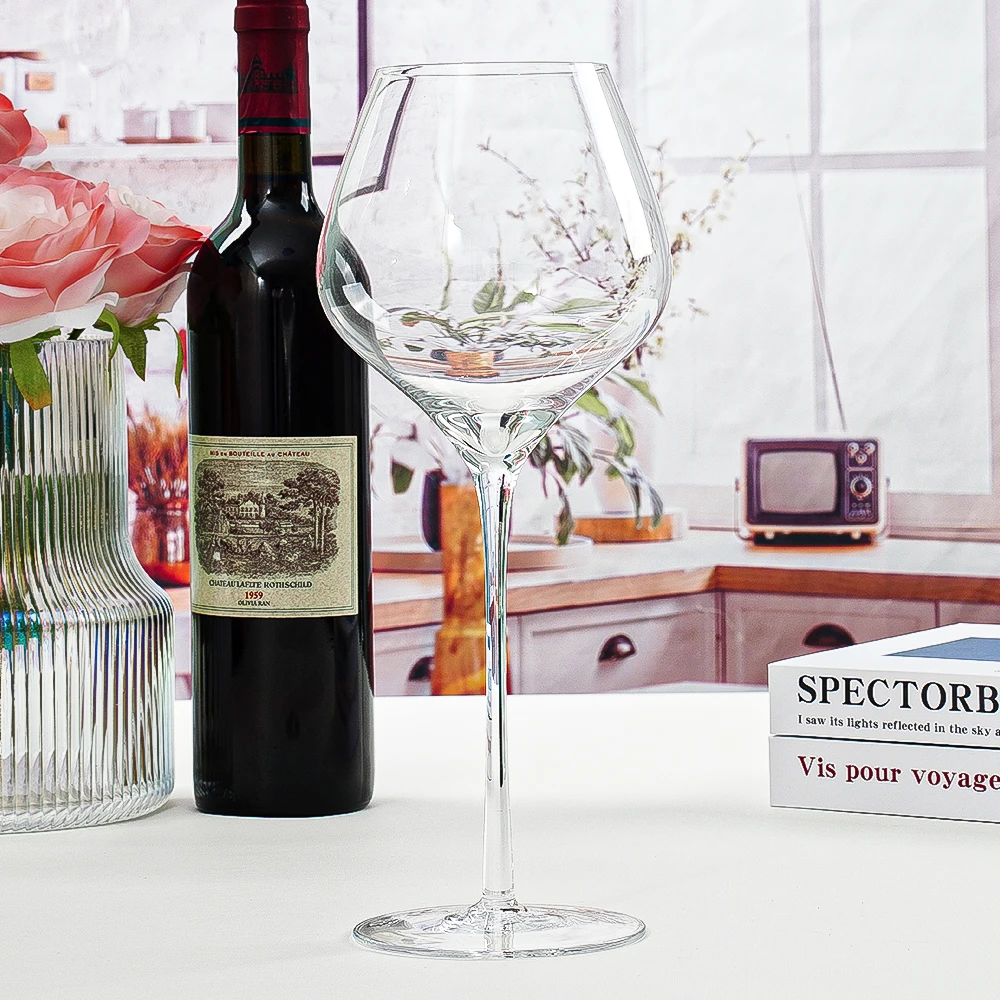
Lead-free crystaltakes a different approach: no lead is added; instead, components such as barium oxide, zinc oxide, and potassium oxide are used to achieve similar refractive index and density effects. In other words, it retains the physical characteristics of high clarity, substantial weight, and a clear ring, but its composition system contains no lead. The Star Luck 780ml wine glass is labeled as lead-free crystal glass and belongs to this category.
For procurement, the practical meaning of this compositional difference is: lead-free crystal and lead crystal can look very similar and are difficult to distinguish by eye and by tapping,The basis for judgment can only be the supplier's material declaration and test documents, not something that "sounds like crystal."。
Why "crystal glasses must contain lead" is a common misconception
This misconception comes from history. Early crystal glass craftsmanship did indeed use lead as the main additive, and the impression that "crystal = leaded" was formed during that period. However, lead-free formulas have long been mature in terms of craftsmanship. In today's crystal glassware on the market, leaded and lead-free are two parallel product lines, not different names for the same thing.
The direct risk brought by this misconception is that procurement judgment gets led astray: some people give up all crystal-type products out of worry about lead and switch to buying ordinary glassware, sacrificing transparency and texture in banquet and bar scenarios;others assume by default that "crystal means leaded" and, in orders that require an explicit lead-free declaration, do not proactively ask suppliers for material specifications, only supplementing the materials when customers or platforms conduct audits.
It should be noted that lead-free does not mean inspection can be waived. Migration of heavy metals other than lead and food-contact compliance depend on the specific formulation, coloring process, and glaze, all of which come down to what documentation the supplier can provide. The product information Star Luck currently makes public only states "lead-free crystal glass, transparent, 780ml, customizable,"and does not include specific test reports or a certification list.。
If your order involves markets such as North America or Western Europe that have explicit documentation requirements for food-contact materials, this step needs to be confirmed separately with the team: which type of test report can be provided, which items it covers, and whether it is issued according to the destination country's standards.
Once the composition layer is clarified, the differences in clarity, sound, and safety have a basis for explanation—they are not three independent selling points, but rather the presentation of the same set of materials and processes across different dimensions.
Clarity, sound, feel: three dimensions for comparing lead-free crystal glasses and ordinary glass glasses side by side
When a buyer places two glasses side by side on the table, what they can usually distinguish first is not the specification sheet, but the signals given by their eyes, ears, and fingers. These three dimensions can help you quickly screen out samples that are obviously wrong, but they can only serve as an initial judgment and cannot replace written confirmation of the material and process.
Refraction and Luster: Why Lead-Free Crystal Glasses Are More "Transparent"
The walls of ordinary glass tumblers often appear to have a slight gray-green or gray-blue undertone, and light passing through looks rather "flat," with the boundary between the glass body and the wine not crisp enough. Because lead-free crystal glass has a higher refractive index, a brighter band of reflection appears along the edges of the glass wall; when you rotate the glass, the outline of the body and the ridges of the stem flash with fine, concentrated highlights. Hold the glass up to a window or light box and rotate it slowly, observing the junction between the base and the wall: crystal samples typically show clearer bright edges and a "deeper" sense of transparency, while ordinary glass tends toward a more uniform, shallow transparency.
It should be noted that,"Transparency" does not equal "true crystal"。 High-white glass can also be made very transparent, and some thick-walled crystal glasses are actually less noticeable under low light. Looking at refraction can only serve as a first round of screening; whether the material is truly lead-free crystal must ultimately be confirmed by returning to the supplier's material specifications and test documents.
Listening to the sound and feeling the wall of the glass: how to understand the clarity and the feel of thickness
When you tap the rim lightly, a crystal glass usually gives a clearer, brighter sound with a longer ring, while an ordinary glass sounds duller and fades quickly. This difference is fairly obvious in a quiet environment, but when there is a lot of background noise, residual water spots on the glass, or fingers pressing on the bowl, the judgment becomes distorted, so it is only suitable as a supplementary reference.
In terms of feel, a common misconception is that "the thicker, the more durable." Thick-walled glasses give a stronger intuitive sense of resistance to knocks, but they are heavier, and the impact force when clinking glasses is also more direct;Thin-walled glasses feel light and offer a pleasant drinking experience, but they rely more on proper cleaning and storage methods. For banquet and bar settings, what really affects the breakage rate is not thickness alone, but the connection process between the stem and the bowl, the annealing quality, and whether staff operate according to standards.
When feeling the wall of the glass, you can also check whether the rim is polished smooth and whether the stem has obvious seams—these details are more worth recording than "how thick it is."
All three dimensions point to the same conclusion: they can help you narrow down the options during the sample stage, butcannot be used alone to determine material or durability. Only by giving the supplier your records of observing refraction, listening to the sound, and feeling the texture, along with your usage scenarios (banquet bulk use, high-frequency bar use, or everyday home use), cleaning methods (whether a commercial dishwasher is used), and customization needs, can you confirm whether this 780ml lead-free crystal wine glass matches your actual usage volume and maintenance conditions.
How to judge safety: lead-free is the bottom line, and certification standards are more reliable than verbal promises
Lead-free vs leaded: risk differences and usage boundaries
The safety of lead-free crystal glasses depends first on the material. For leaded crystal, there is discussion of the potential risk of lead leaching during long-term contact with acidic beverages and when the rim is worn;lead-free crystal replaces lead with other metal oxides, avoiding this concern. Ordinary glass is likewise lead-free, and its safety is usually uncontroversial; the difference mainly comes down to clarity and feel.
Therefore, lead-free is the baseline for purchasing, not a bonus point—especially when the glasses are to be used frequently in food service and exposed to the acidic environment of alcoholic beverages, lead-containing materials should not enter the procurement list.
How to interpret certifications: what ROHS, CE/EU, FDA, and LFGB each mean
"Lead-free" is a material declaration; a verbal promise is not the same as something verifiable. ROHS mainly restricts hazardous substances in electrical and electronic products, and its applicability to food-contact glassware is limited;CE/EU is a compliance mark for access to the EU market, and it does not mean that food-contact safety has been separately verified;FDA is the U.S. compliance framework for food-contact materials;LFGB is the German law on food and everyday goods, and it is often used as a relatively strict reference. The key is that the certification must correspond to the target market, the material, and the food-contact parts.
Which certificates Star Luck specifically holds and which models the reports cover need to be confirmed with the supplier; this article does not draw conclusions on their behalf. When purchasing, first confirm that the material is lead-free crystal, then request test documents matching the target market, and check that the model numbers and test items on the reports match.
Which one to choose in the end: conclusion boundaries based on scenario, budget, and maintenance capability
Wedding banquets, restaurant bars, daily home use: who the Star Luck 780ml glass suits and who it does not suit
This Star Luck 780ml lead-free crystal wine glass is best suited foroccasions that require "tabletop visual presentation": wedding banquet head tables, hotel banquet table settings, bar presentation displays, and gift or set customization. The transparency and crystal-like clarity of the cup body are something ordinary glass cups can hardly replace;the 780ml large capacity also gives it a stronger presence in banquet and display-oriented settings, rather than following the lightweight route of everyday small sips.
The unsuitable situations are equally clear:
- Restaurants with high-frequency table turnover and manual quick-rinse cleaning: large cup sizes take up space and make the cup body more "conspicuous," with higher chances of knocks and storage pressure than regular cup sizes.
- Households that only drink a small cup daily and have tight cabinet space: 780ml is on the large side for most people's daily drinking volume—pouring half a cup looks empty, while filling it exceeds habit.
- Bulk purchases with a very tight budget that only seek "something that can hold liquor"In this type of requirement, ordinary glass tumblers are more cost-effective; there is no need to pay a premium for clarity.
Is 780ml too large and inconvenient to use? The key depends on the use:For table displays, banquets, and presentation-style servings, it is a plus;for daily personal drinking and compact storage, it is a minus. It is better suited to scenarios of "one glass on the table, visual impact first" rather than scenarios that pursue lightweight, high-frequency use.
The tradeoff between budget and maintenance: when lead-free crystal is not worth it
The cost of lead-free crystal glasses lies not only in the purchase price, but also inDamage replacement and cleaning methods。 Can crystal glasses be washed in a dishwasher? This depends on the stem craftsmanship and commercial washing conditions. The available information does not provide a clear conclusion, so I cannot guarantee it for you.
If you plan to use a commercial dishwasher with high-temperature and high-pressure washing, or if your staff's cleaning process is relatively rough,do not estimate the lifespan of crystal glasses based on the maintenance standards for ordinary glassware—this will directly affect your replacement budget.
So the boundary of the conclusion is:
- Lead-free crystal is worth choosingBanquet halls, hotels, bars, and similar settings where presentation is the core focus, and where standardized cleaning, separate storage, and a certain breakage rate can be accommodated.
- Ordinary glass tumblers are more suitableHigh-frequency, rough handling, budget-first settings where durability and low maintenance are the top priorities.
- Not worth adding complexityYou haven't yet confirmed the cleaning method, storage conditions, and restocking rhythm, yet you're already putting crystal glasses onto high-frequency use lines—what you're adding here isn't experience, but management burden.
For the Star Luck 780ml model specifically, the next step is to confirm three things with the team: the stem craftsmanship and cleaning recommendations, bulk packaging and storage methods, and the minimum order conditions for custom logos or patterns. Once these three items are confirmed, you'll basically have your answer on whether to choose it.
Frequently Asked Questions
How much liquor is appropriate to pour into a 780ml glass? It is on the larger side, suitable for pouring about half a glass while leaving room for the aroma, or for banquet display-style servings;if you are used to small portions for personal drinking, this capacity will seem empty.
Are lead-free crystal glasses definitely more durable than ordinary glass glasses? Not necessarily. Clarity and texture are its advantages; durability depends on the craftsmanship and how it is used, and in high-frequency rough-use scenarios the risk of breakage needs to be assessed separately.
Can it be put in the dishwasher? The available information does not clearly state this; you need to confirm the stem craftsmanship and cleaning recommendations with the Star Luck team before deciding, and do not assume it can be handled like an ordinary glass glass.
Can the logo or cup body pattern be customized? The product information shows that Logo / image-based customization is supported; specific minimum order quantities, sampling, and packaging requirements need to be confirmed with the team.
Learn more
If you are selecting a large-capacity wine glass with tabletop presence for a wedding banquet, hotel banquet, or bar output line, you can send us your usage scenario, estimated quantity, cleaning method, and customization requirements.The Star Luck team will work with the process conditions of the 780ml lead-free crystal Burgundy glass to help you confirm the material documentation standards, packaging and storage methods, and customization minimum order conditions, and then decide whether to proceed to the sample and mass production stages.
Related products:HOT Wholesale Large Wine Goblet Product and Crystal Glass Burgundy Glass Products Red Wine Glass