
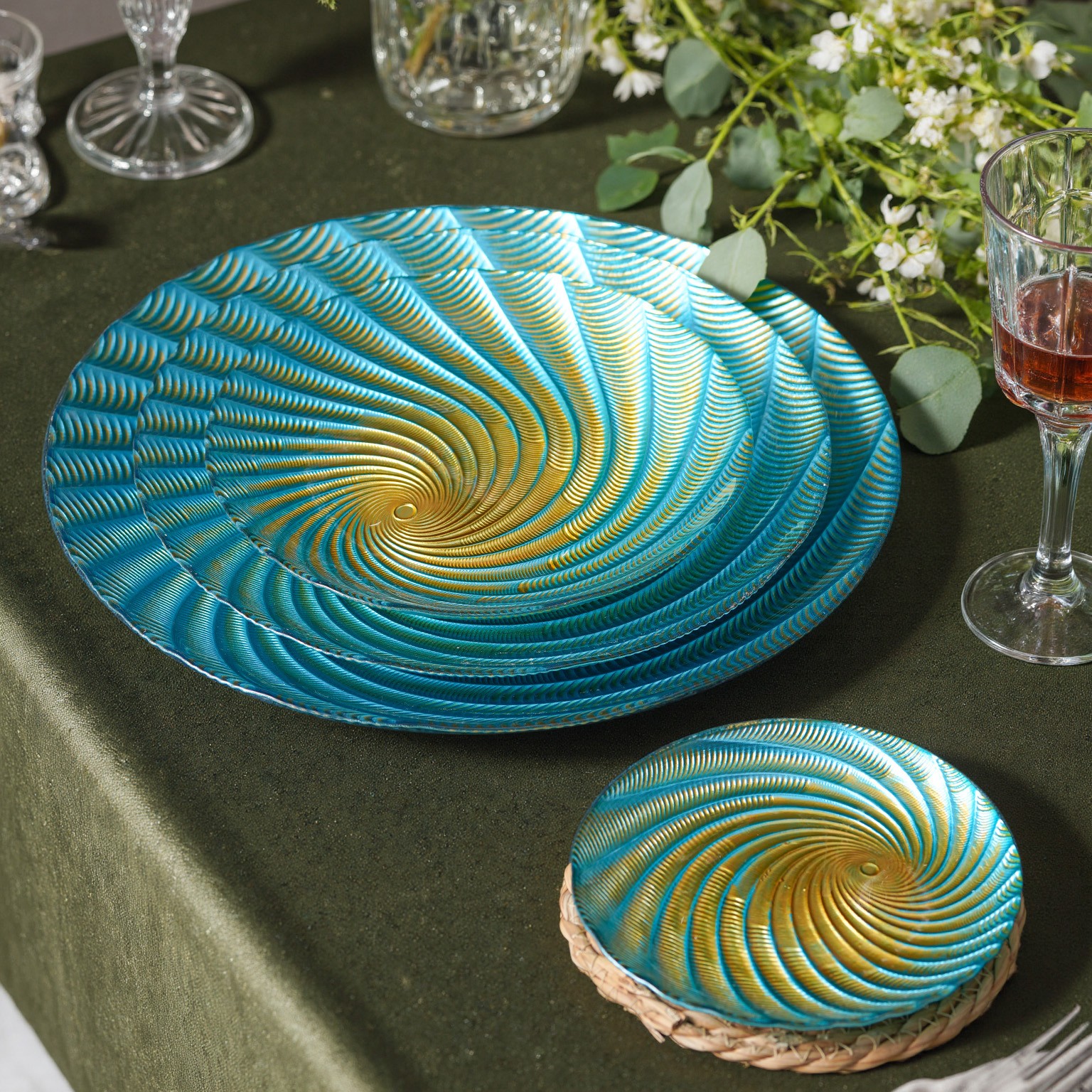
What is a custom blue and gold glass dinner plate: does it solve the problem of color coordination, or the problem of plate shape and use?
Wedding Dinner Party Blue and Gold Custom Color Round Glass Plates are Star Luck's round glass dinner plates, with two core variables: the custom blue and gold color and the round plate form. They correspond to two independent decisions—color coordination determines whether they can blend into the themed table setting, while the plate shape and use determine whether they can hold food and whether they can be turned over at high frequency. Only after clarifying these two things does it make sense to discuss business terms.
The practical role of the custom blue and gold color and the round shape in wedding banquets
The custom blue and gold color addresses the color consistency of the entire place setting: whether the tablecloth, the metallic color of the cutlery, and the blue and gold of the plate surface fall within the same color family. It does not change heat resistance, wash resistance, or load-bearing capacity. The confirmation action is proofing and comparison—checking the actual custom-color sample against the actual tablecloth and cutlery under the same light source, rather than only looking at color cards or pictures. The round plate shape, on the other hand, determines the boundary of use, and does not answer the question of "whether it can hold food."
In the scenario of allocating place settings by table count for a blue-and-gold themed wedding banquet, unified color coordination is the visual value, while plate type and use are the prerequisite for suitability.
The capability boundaries of Dinner plates for everyday use or entertaining
In the product information, the corresponding positioning is Dinner plates for everyday use or entertaining, that is, scenarios for daily use or entertaining guests. However, whether the blue-and-gold decorative rim contacts food, whether it can go in the dishwasher, and whether the specific dimensions correspond to dinner plates or decorative charger plates—the available information does not provide clear specifications. These are questions of plate type and use, and they directly affect labor and breakage costs in high-frequency washing scenarios such as hotel buffets and rental companies' peak-season turnover.
It is recommended to first distinguish decorative plates from dinner plates: when used only for visual display, focus on confirming custom color matching;when they will contact food and be washed repeatedly, you must first confirm with the Star Luck team the conditions for the gold-rim process contacting food and the cleaning method, and then proceed to bulk inquiry. Before the boundaries of use are confirmed, it is not recommended to proceed on the basis of “one plate for multiple uses, machine washable, and suitable for holding hot food.”
Is a 13-inch large plate a dinner plate or a decorative charger plate: which scenarios are suitable for use, and which are not recommended?
13-inch glass plates are mostly used in wedding banquets and hotel settings asdecorative charger platesfor use: placed at the bottom layer of the place setting to support napkins, menus, or soup bowls, and they do not directly contact food themselves. To determine which category it belongs to, the key is to look atwhere the decorative craftsmanship is located—if the gold rim or beaded edge is on the plate rim or plate surface, both food contact and cleaning methods will be restricted. Before placing an order, "table display decoration" and "food serving" should be separated into two uses and confirmed separately; it is not recommended to use one plate to cover both roles.
Method for confirming plate allocation by table count and full place setting color matching
Wedding tableware bytable countEstimating main plate usage by table count is closer to reality: allocate plates per place setting per table, then multiply by the number of tables, and add about 5%–10% spare to handle breakage and temporary extra seats;Ordering by number of people easily misses spare plates and display positions. For color matching, blue-gold plates need to be sampled together with the tablecloth base color and the metal color of the cutlery; it is recommended to first make a complete place setting sample (plate, cutlery, glass, napkin) and confirm it under the venue lighting, then lock in the batch color. Blue-gold contrast is strong, and batch color differences are more obvious than on a single piece, so sample confirmation is a necessary prerequisite.
Cleaning boundaries and unsuitable scenarios for gold-rim/beaded-rim craftsmanship
Gold-rimmed and beaded decorative plates are not recommended for direct contact with food, and are especially unsuitable for serving oily or acidic dishes or dishes that need to be heated;For cleaning, hand washing is mostly required; avoid high temperatures and strongly alkaline detergents in dishwashers, otherwise the decorative layer risks abrasion. This directly affects rental turnover and hotel back-of-house labor costs: high-frequency cleaning scenarios should be estimated based on hand-washing labor hours, not on dishwasher efficiency.
Suitable and Not Recommended
| Scenario | Judgment | Key Reason |
| Blue-and-gold wedding plates arranged per table | Suitable | Clear decorative positioning; the entire set of place-setting samples allows controllable color coordination |
| Hotel banquet + buffet dual scenarios | Suitable; tiered selection required | Select decorative plates and serving plates separately to avoid mixing them |
| Rental company peak-season turnover | Suitable; manual hand-washing labor must be assessed | Hand-washing of beaded/gold-rimmed items affects turnover efficiency |
| Cross-border stocking by wholesalers | Suitable | Need to balance MOQ, breakage rate, and ocean shipping lead time |
| Dual use for daily family meals and festive occasions | Not recommended as a primary push item | Decorative plates do not contact food, and multi-purpose use of a single plate has its limits |
Whether the gold rim can go into the dishwasher, the wash resistance of the decorative layer, and the specific plate mix ratio require providing Star Luck team with the number of tables, cleaning method, and dish types to confirm a matching solution.
How MOQ, sampling lead time, and delivery lead time stack up: a business terms evaluation checklist for custom blue-gold dinner plates
When customizing blue-gold glass dinner plates, the minimum order quantity, sampling, and delivery lead time constrain each other and need to be checked item by item.
MOQ and tiered pricing logic: a low minimum order quantity does not mean any small batch size is acceptable
A low MOQ does not mean you can place orders in arbitrarily small batches. Custom colors and logos usually involve color matching, plate making, or screen printing processes, and the upfront costs need to be allocated across each plate, so a common practice is to set tiered pricing: the closer the quantity is to the MOQ, the higher the unit price;once a certain tier is crossed, the unit price decreases. When requesting a quote, you should ask Star Luck to specify the quantity range and unit price corresponding to each tier, rather than only quoting a single starting price.
If plates are allocated by the number of tables and the total quantity is relatively small, you need to decide in advance whether to accept a higher unit price or combine orders for subsequent events to spread the cost.
The stacking relationship among sampling fees, color difference confirmation milestones, and standard lead time plus custom add-on time
Sampling usually includes color matching samples and logo samples; whether the fees can be deducted from bulk orders and how long the sampling cycle takes need to be confirmed at the inquiry stage. The blue-and-gold color scheme is sensitive to lighting and batch, so it should be confirmed against physical samples during the proofing stage by comparing with the tablecloth and the metal color of the cutlery, and the confirmed sample should be retained as the basis for bulk acceptance;Color difference confirmation should be completed before placing the bulk order, and the bulk delivery schedule should not start being calculated before the confirmation sample is signed.
Regarding lead time, the industry's common standard lead time is about 6–10 weeks, with customization adding about 4–6 weeks (the source is an industry experience range; different suppliers and processes vary considerably, for reference only). Standard lead time generally refers to the mass production cycle for conventional colors without a custom logo; custom color schemes and logos will add time for processes such as plate making, color matching, and screen printing on top of that. When evaluating, it is necessary to ask clearly from what point the standard lead time is counted (order placement or confirmation sample signing), and whether the customization add-on is a fixed number of days or varies with quantity;Only the sum of the two is the committable lead time, rather than taking the longer one.
Star Luck's specific MOQ, unit price, proofing fee, proofing cycle, and lead time are subject to confirmation upon inquiry. When making an inquiry, it is recommended to provide at one time the estimated total quantity and batch shipment plan, color reference, logo file and placement position, and target arrival date, and to ask the other party to reply in writing accordingly, then work backward to determine the order placement time.
How to choose in the end: in what situations is customization worthwhile, when should you choose a simpler solution, and where is the budget boundary?
The boundary between recommended and not recommended conclusions
The situations where customization is worthwhile are fairly specific: the blue-and-gold color scheme is a part of the wedding or banquet visual plan that must be reproduced precisely, the tablecloths, the metallic color of the cutlery, and the floral arrangements have already been finalized, and you can match plates according to the number of tables and accept proofing and lead times set in advance. For this type of procurement, doing glass dinnerware OEM pays off because confirming samples for the entire place setting can resolve color deviation in advance.
The situations where adding complexity is not recommended are equally specific: the intended use is still changing (it has not been decided whether they are dinner plates or decorative charger plates), whether they will contact food has not been confirmed, and there is an expectation of arbitrary small batches or one plate serving multiple purposes. If these items are not settled, custom proofing amounts to magnifying uncertainty into a bulk order. If you only want a “blue-and-gold atmosphere,” have few tables, or have a very tight schedule, standard-color plates plus soft-furnishing color accents are more cost-effective.
The alternatives each have their boundaries: ceramic bone china is wash-resistant but weaker in decorative appeal and transparent texture;Acrylic is low in cost, but its texture does not match high-end scenarios;rental suits a single wedding, but the long-term cost is relatively high. Customization is not one of the key choices; it depends on whether you want a one-time event effect or a reusable asset.
Budget allocation order and tradeoffs: upfront investment in proofing vs. hidden costs of cleaning and breakage
The budget should prioritize proofing rather than packaging. Proofing confirms color, plate shape, gold-rim craftsmanship, and food-contact safety—issues where a mistake means the entire batch is scrapped;packaging can be adjusted later according to the shipping method and is an execution-level investment. However, cleaning labor (gold rims and beaded edges usually require hand washing) and breakage replenishment are long-term hidden costs; when comparing prices, they must be calculated together with the unit price, otherwise a low-price option may end up costing more during peak-season turnover.
Specific MOQ, sampling lead time, and delivery time need to be confirmed with Star Luck through an inquiry based on the number of tables, usage, and washing conditions.
Frequently Asked Questions
If the number of tables is small, is it still worth customizing samples for blue-gold? It depends on whether the color is a hard constraint. If the wedding visuals have been finalized and color differences would be noticed at a glance, sampling is still worth it;if it is only an ambiance requirement, standard colors plus soft furnishings are more hassle-free.
If the budget is tight, can sampling be skipped and the order placed directly? Not recommended. Skipping the sample saves a small amount of money, but you are gambling with the color and craftsmanship of the entire batch. Once they do not match, the cost of rework or replacement is far higher than the sampling fee.
Can this plate go in the dishwasher? Gold rim and beaded edge decorations usually involve hand-wash maintenance. Whether they can be machine washed specifically needs to be confirmed with Star Luck for the process instructions, which directly affects the labor cost estimate.
Is there a difference in selection between decorative use and food-contact use? Yes. If it is only for decorative charging plates, there is more room for selection;if it is to contact food, the plate shape, coating, and cleaning method all need to be reconfirmed and cannot be mixed.
Learn more
If you are matching plates for a blue-and-gold themed wedding or banquet, you can send the number of tables, seats per table, intended use (decorative charger plates or food-contact use), cleaning method, and target delivery date to the Star Luck team. Based on this, we will reply with MOQ tiers, sampling arrangements, and a committable lead time to help match a suitable solution.