
What Exactly Is Being Wholesaled in Wholesale Crystal Wine Glasses: First, Clarify the Purchasing Target of 780ml Lead-Free Crystal Glasses
"Wholesale crystal wine glasses" is not a category that can be quoted directly; rather, it is a set of purchasing needs that must be tied to specific models. When you ask about MOQ, samples, or lead times, the supplier must first know which glass shape, what capacity, and what material you are referring to; otherwise, the numbers given have no comparative meaning. This section first locks the purchasing target onto Star Luck's SL-1002, then discusses the thresholds.
Product Facts and Suitable Scenarios of This SL-1002 Burgundy Glass
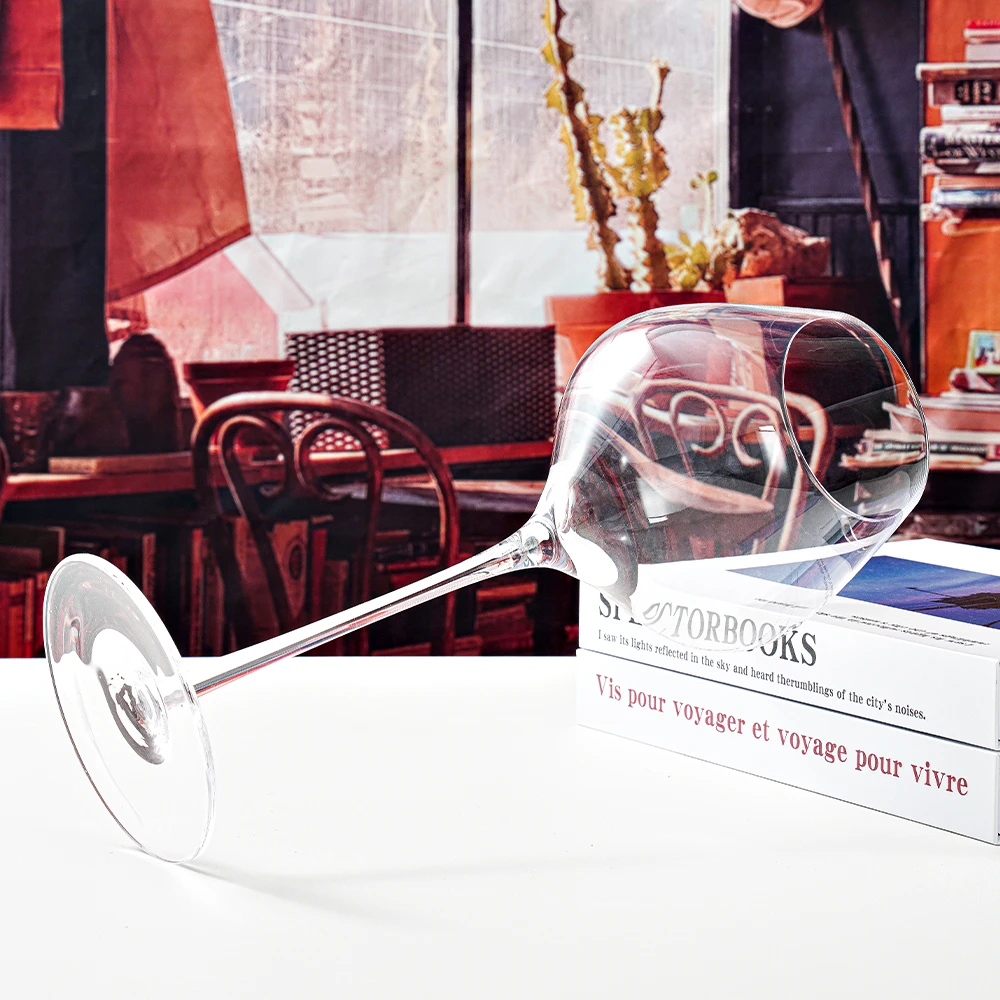
The SL-1002 is a Burgundy glass with a capacity of 780ml, a transparent body, and lead-free crystal glass; it is visually clear and glossy, and supports Logo and custom design customization. 780ml is a relatively large glass type, with a wide bowl and a tapered rim, mainly used in red wine drinking scenarios that require the wine to fully contact the air.
From the perspective of usage scenarios, it corresponds to three types of buyers:
- Wedding banquets and event planning: Large-capacity glasses have a strong visual presence on banquet tables, and the clear crystal texture is suitable for uniform arrangements;however, using them in bulk means cleaning, handling, and breakage all need to be factored in advance.
- Restaurants and bars: Suitable for venues that focus on red wine and are willing to use glassware to enhance the presentation of their offerings;high-frequency commercial washing is a real test of the craftsmanship of the stem and bowl.
- Everyday home use, home retail, and custom gifts: 780ml is on the large side for everyday single-glass drinking, making it more suitable as part of a glassware set or as a gift product;Cross-border sellers, on the other hand, need to consider both volumetric weight and breakage rates at the same time.
Why procurement thresholds should start with the product definition
Threshold figures such as MOQ, sample fees, lead times, and certifications all depend on the product definition. Take the same "crystal wine glass": change the capacity, change the glass shape, or change whether a custom logo is required, and the minimum order quantity, tooling or printing arrangements, and production scheduling will all change. If you ask for a price quote with a vague "crystal glass," the reply you get can only serve as a reference and cannot be written into a procurement contract.
So this section asks you to confirm one thing first: is what you want to order in bulk the SL-1002 780ml lead-free crystal Burgundy glass, and do you need a logo / custom design from artwork? Once these two points are settled, the threshold checklist that follows will have a specific subject. As for whether this glass can meet your commercial washing conditions, whether the packaging method can be adjusted to your channel requirements, and whether other capacities are available, these are not things that public information can determine for you; you need to tell the Star Luck team your actual usage conditions, and they will confirm a matching solution.
How to ask about MOQ and sample policy: state your scenario first, then ask about quantities; confirm sample fees and tooling fees separately
If you only ask "what's the minimum order quantity," you'll usually just get a number, and that number may not match your actual order. MOQ is often tied to the model, customization method, and packaging format: for the same 780ml lead-free crystal wine glass, the minimum order threshold may be completely different for stock items versus Logo customization, and for bulk packing versus color box packing. First explain your own usage scenario clearly, then ask about quantities, so the supplier can give you an executable quote and production scheduling conditions.
How to ask about MOQ: ask based on the three elements of model, scenario, and packaging method
In your inquiry, specify at least three things: first, the model—write a specific model like SL-1002 directly, to avoid the other party quoting based on a different glass type;second, the use and batch rhythm, such as a one-time full setup for a wedding banquet, long-term replenishment for a bar, or a distributor taking delivery in batches—this affects their judgment on whether you need a stock-type partnership;third, the packaging method—bulk packing, standard color boxes, and custom gift boxes often correspond to different minimum order quantities.
Question templates that can be copied directly:
We plan to purchase SL-1002 (780ml transparent lead-free crystal wine glasses) for wedding banquet/catering channels. The first order is expected to be X pieces, with subsequent quarterly replenishment.Please inform us separately: What is the MOQ for each of the following three cases: in-stock bulk, standard color box, and customized Logo?Do you support mixed loading to reach the quantity?
The specific MOQ value for Star Luck needs to be confirmed with starluck; do not apply numbers from other companies' glass styles.
Whether samples are charged and whether the sampling fee is refundable must be confirmed in writing.
"Do samples cost money?" and "Is the sampling fee refundable?" are two separate questions. The former refers to the cost of in-stock samples, while the latter refers to the sampling investment for adding a Logo or changing packaging. Many suppliers have different rules for handling these two items. The content that needs written confirmation includes: who bears the sample unit price and shipping cost, the amount of the sampling fee, at what quantity of bulk order the sampling fee can be deducted or refunded, and when the samples will be sent out.
Verbal promises are easy to mismatch in subsequent orders; putting them in an email reply creates a record.
Question templates that can be copied directly:
Please confirm: ① whether in-stock samples are charged, how much the fee is, and how shipping costs are borne;② whether custom Logo sampling incurs an additional sampling fee, and how much it is;③ at what quantity of the first order the sampling fee can be refunded or deducted;④ how many days it is expected to take to send out the samples.
Ask these two sets of questions clearly at once, and what you get is not just a number, but a complete threshold that can be directly calculated into your procurement cost.
How to lock down lead time and container loading quantity: from which date the lead time is counted, and whether it is FCL or LCL, determines your arrival rhythm.
Lead time is most easily compressed into a single number in an inquiry, such as "30 days." But this number is of almost no direct use for scheduling your arrival and shelf placement, unless three things are clarified at the same time: from which date it is counted, which steps are included in between, and how the goods are loaded into containers. If any one of the three is not aligned, the actual arrival rhythm may deviate from expectations.
Lead Time Start Point and Influencing Factors: Customization, Packaging, Peak-Season Scheduling
There are usually three reference points for the lead time start: the date the deposit is received, the date samples or proofing are confirmed, and the date all packaging materials arrive. For this customizable Logo / custom-design lead-free crystal glass, the difference in start points is especially obvious—if counting starts from the deposit date, but the glass body pattern or packaging has not yet been confirmed, production cannot actually begin, which effectively hides the confirmation time inside the lead time.
The steps that affect the cycle are mainly: customization confirmation (Logo, pattern, packaging method), mass production, packaging and cartoning, pre-shipment inspection and space booking. Peak-season scheduling will further lengthen it; banquet and festival procurement is concentrated before the order peak, and scheduling order often depends on the sequence in which confirmations are completed, not the sequence in which inquiries arrive.
Next steps: Confirm three things with Star Luck—from which point the lead time is counted, how many days the customization confirmation and packaging confirmation each take, and whether extra production scheduling time needs to be reserved during peak season. The specific number of days must be confirmed with starluck; do not substitute industry conventions.
The impact of the difference between FCL and LCL container loading volumes on procurement scale requirements
The difference between full container load (FCL) and less than container load (LCL) is not just freight cost, but a hard constraint on your procurement scale:
- FCL: Load according to the full container volume; a single batch purchase quantity must be able to fill the container space to be cost-effective, suitable for banquet season stocking, unified distribution to chain stores, and dealer stockpiling.The advantage is that you control the loading schedule, goods are not mixed with others, and there are fewer disputes over damage and handover.
- LCL: Billed by volume or weight, with a low shipping threshold, suitable for first-order trial sales, replenishing wedding projects by event, and small-batch product testing for cross-border e-commerce.The trade-off is that LCL involves multiple loading and unloading cycles, so fragile items like glass cups have higher packaging strength requirements, and arrival times are also affected by other cargo in the same container.
The way to judge is straightforward: first calculate the total volume corresponding to your planned purchase quantity, then compare it with the container capacity—if it is close to a full container, negotiate FCL; if it is clearly insufficient and there are no short-term replenishment plans, go with LCL and simultaneously confirm the packaging reinforcement plan. This 780ml large-capacity cup takes up a considerable amount of space per unit, and the packing quantity has an obvious impact on volume,The specific quantity per carton, container load capacity, and minimum order quantity need to be confirmed with starluck。
Suitable/unsuitable judgment: For those whose arrival time is locked to a specific event date and whose volume is sufficient for a full container, prioritize FCL and lock in the starting point;For first-time cooperation, uncertain quantities, or those wanting to validate the market first, use LCL, but you must clarify packaging strength and the responsibility for handover during consolidation. The situation where neither is suitable is: when neither customization nor packaging milestones have been confirmed, and a fixed arrival date is demanded—at this point, any delivery commitment is unreliable.
How to ask about certifications without falling into traps: lead-free declarations, ROHS/CE/EU/FDA/LFGB interpretations, and certificate numbers must be put in writing.
When purchasing crystal wine glasses, "lead-free" and "certified" are often discussed together, but they are actually two different things. Lead-free is a fact about the product material, supported by material specifications and test reports;ROHS, CE/EU, FDA, and LFGB are compliance evidence at the documentary level, corresponding to market access concerns in different markets. Only receiving the statement "we are lead-free" does not mean you have obtained the documents needed for customs clearance, shelf placement, and responding to customer audits.
Material declarations and certifications are not the same thing: lead-free is a product fact, certification is documentary evidence.
A lead-free declaration answers "is there lead in the cup"; a certification certificate answers "this product has been tested against a certain standard and the result passed." The former is a product attribute; the latter is a document with a number, an issuing body, and a validity period. When purchasing, ask separately: what test report is the lead-free claim based on, and which model and which batch of material does the report correspond to;what is the certification certificate number, which models does it cover, and when does it expire.
Which certifications Star Luck specifically holds, along with certificate numbers and validity periods, must be confirmed in writing with the starluck team before being written into a contract or purchase order.
Ask about certifications according to the target market: North America, Western Europe, Russia, the Middle East, and Southeast Asia each have different priorities
- North America: the FDA framework is often used for food-contact materials; clarify which component and which test.
- Western Europe: Under the CE/EU framework, focus on food-contact compliance. LFGB is the commonly used standard in Germany. For exports to Western Europe, you can prioritize asking for LFGB or the corresponding EU framework documents.
- Russia: Focus on local market-access documents. You need to confirm the specific certificate type; CE cannot be used as a substitute.
- Middle East, Southeast Asia: Requirements vary by country. Confirm them one by one according to the destination country, and do not assume that "having CE means it can enter all markets."
When putting it in writing, require scanned copies of the certificates, and check whether the number, issuing body, validity period, and covered models include the specific model you are purchasing;Request the lead-free declaration and test report together, and confirm that the model in the report matches the model in the order;Write the certificate number, validity period, and lead-free commitment into the procurement contract or order remarks. If the supplier can only give verbal assurances or a vague "meets the standard," don't rush to place an order—what's missing is verifiable documentary evidence, and what's affected is customs clearance and subsequent customer audits. List the above conditions for the starluck team, confirm which can be provided and which need to be supplemented, and then decide whether to proceed to sample and MOQ negotiations.
Frequently Asked Questions
Q: Does lead-free crystal glass necessarily not require ROHS or FDA documents? No. Lead-free only means the material contains no lead; ROHS, FDA, and LFGB are separate compliance frameworks, and whether they need to be provided depends on the target market and customer requirements—the two cannot substitute for each other.
Q: Is it enough to write the certificate number on the quotation? Not enough. A quotation is not a compliance document. You should request scanned copies of the certificates and verify the certificate numbers, validity periods, and covered models, and if necessary, include them in the contract.
Q: Can different capacities of the same cup share one certificate? Not necessarily. Certificates are usually issued to cover a model or series. You need to confirm whether the 780ml model you are purchasing is within the covered scope; do not assume that all models in the same series are covered.
Q: What certifications does Star Luck currently hold? The available information does not list a specific certification inventory. You need to confirm with the starluck team the certificate types, numbers, validity periods, and covered models before making a judgment.
Learn more
If you are evaluating this 780ml lead-free crystal Burgundy glass for wedding banquet setup, chain store distribution, or cross-border product testing, you can organize your planned purchase quantity, packaging method, target market, and delivery schedule and send them to the Star Luck team.Based on that, we will confirm the MOQ, sample and proofing arrangements, the starting point for calculating lead time, and the certification documents we can provide, helping you turn the inquiry into executable purchasing terms.
Related products: