Hand-blown peacock-shaped glass vase—what exactly determines its durability?
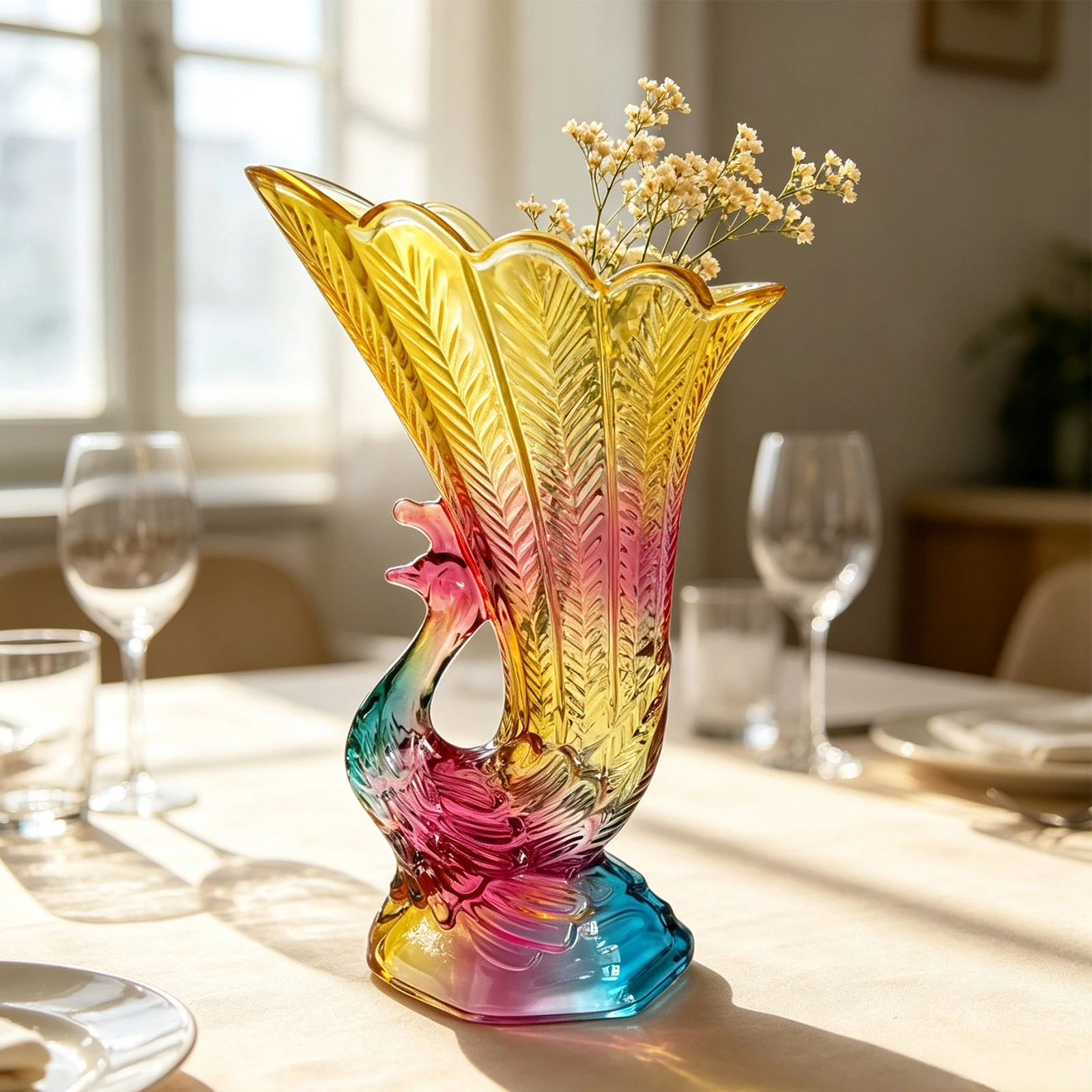
Hand-blown is often treated as a synonym for "fragile," but what really determines whether a vase can withstand daily handling, the stress of holding flowers, and the bumps of transport is not the label "handmade" or "machine-made," but whether the wall thickness is uniform, whether the raw material is pure, and whether stress concentrations exist at the transitions in the shape. The advantage of hand-blowing lies precisely in this: an experienced glassblower can adjust the properties of the glass in real time at irregular transitions such as the neck and tail feathers of the peacock shape, making the wall thickness transition smoother;whereas products with uneven wall thickness often crack first at the thin spots. So "handmade = not durable" mistakes the production method for a quality conclusion; there is no high-probability relationship between the two.
Why wall thickness uniformity matters more than the "handmade/machine-made" label
Glass vase breakage mostly starts at the thinnest point. The peacock shape has a slender neck and spread tail feathers with large curvature changes; if the wall thickness suddenly becomes thinner from the body to the edge, the lateral force when arranging flowers, the temperature difference during cleaning, and the vibration during transport will all concentrate on the thin wall. To judge whether the wall thickness is uniform, you cannot rely only on the visual clarity; a more practical approach is to slowly rotate the bottle body against a light source and observe whether the light-transmitting band is continuous and whether there are localized whitish areas or dark bands;gently run your hand over the bottle mouth and the edges of the tail feathers to feel whether the thickness is consistent.
These are actions that can be done on the spot when inspecting samples during procurement, and they are more useful for predicting durability than asking whether it is "handmade."
The relationship between the purity of lead-free glass raw materials and strength
Lead-free glass and tempered glass are not the same thing. Tempered glass is a finished product that undergoes heat treatment to form surface compressive stress, which belongs to the strengthening process;lead-free glass refers to the material formulation not introducing lead, which belongs to the category of material. Lead-free glass does not automatically gain tempered-grade impact resistance just because it is "lead-free," but pure raw materials with few bubbles and stones can indeed reduce the starting points of cracking caused by internal defects.
The Star Luck peacock-shaped vase (model SL-GV-083) is listed as lead-free glass, hand-blown, with dimensions of 12×27.5cm and a weight of 1283g, available in clear and multiple color options—these are known product facts, but the specific wall thickness tolerance and whether it has undergone annealing treatment are not provided in the materials and need to be confirmed with the team.
For buyers and floral studios, the assessment sequence can proceed as follows: first clarify whether the use scenario is home display, wedding table flowers, or cross-border long-distance transport;then confirm wall thickness consistency and packaging method for the scenario;only at the end discuss color and customization. If used in high-frequency handling wedding scenarios, wall thickness uniformity and packaging cushioning are far more important than the "handmade" label;if it is only for fixed hotel display, appearance clarity and shape fidelity carry higher weight. As for expectations like "more secure and unbreakable," no glass product can promise that; the reasonable approach is to write acceptance criteria into the sample confirmation stage.
What scenarios can this peacock vase be used in?Scenarios where it is not recommended
With its 12×27.5cm size and 1283g weight, it won't block the view of guests across the table when placed in the center of a long wedding table or round table; a single hydrangea or a few stems of Eustoma will be enough to create a table centerpiece;Moved to a sideboard in the living room or a console table in the entryway, it becomes a sculptural standalone display piece. The hand-blown peacock silhouette and the translucent body make it better suited to a position where it is "seen and admired" rather than a position where it is "frequently picked up."
Reasons why it suits home decor and wedding table centerpieces
For home decor, the lead-free glass is transparent and safe, and the minimalist shape suits living room sideboards, entryways, or dining room sideboards;However, at 1283g it is not light, so shelf load-bearing capacity and logistics costs need to be assessed in advance. For wedding banquet table centerpieces, the peacock shape is distinctive, and the transparent and multi-color options can match different themes;Please note that hand-blown batches may have color variations; it is recommended to agree on an acceptable range with the supplier in advance. Used as a glass vase for wedding table centerpieces, a single piece creates a scene on its own, and multiple pieces can be arranged together, suitable for serving as the visual focal point on the main table or guest tables.
Spare parts and maintenance recommendations for high-frequency contact scenarios
For long-term display in restaurants and clubs, the glass material is easy to clean and has a strong transparent feel, but high-frequency contact increases the possibility of bumps and replacements. It is recommended to reserve spare parts according to usage locations when purchasing, which is more reliable than replenishing a single piece afterward. When changing water, support the bottom of the vase rather than pinching the peacock neck; clean with a soft cloth and neutral detergent. If used for temporary scenarios such as party decorations and budget is the priority, a lighter alternative can be considered;if you are pursuing photogenic results, this piece can still serve as an accent.
For specific spare-part ratios and alternatives, it is recommended to confirm with the Star Luck team based on table turnover frequency and placement height.
How do you determine whether the durability is sufficient when purchasing?Checklist for confirming samples and packaging
Hand-blown does not mean "highly likely to break," but durability indeed cannot be judged by a single phrase like "long-lasting and durable." For buyers and event planners, there are really two things to confirm: the condition of the sample itself, and whether it will break during the journey from the factory to your warehouse.
Sample evaluation: how to assess wall thickness feel and clarity
This vase measures 12×27.5cm and weighs 1283g; it should feel noticeably substantial in hand. During evaluation, you can check the following points:
- Whether the wall thickness is uniform: Focus on feeling the bottle mouth, the peacock-shaped tail feathers, and the transition area at the base.Hand-blown glass allows slight variations in thickness, but one side should not be noticeably thinner, nor should it appear whitish or grayish when light passes through.
- Clarity: Hold the bottle body up to natural light; lead-free glass should be clear and bright with few impurities.For multi-color versions, confirm whether the color comes from the glass body itself or from a surface treatment; the former is more resistant to daily wiping.
- Seams and Base: Check whether the base is flat and whether there are obvious clusters of bubbles or sharp burrs, as these directly affect stability on the table and the feel when carrying.
- Samples can be providedThe supplier supports sending samples; it is recommended to get at least one transparent version plus one in the target color, so you can judge for yourself by handling them rather than just looking at pictures.
What you need to confirm with the supplier is: whether the samples and the bulk goods use the same process and raw material batch, and whether there is an acceptable range for wall thickness. These two points will directly determine whether the bulk goods you receive match the samples.
How should the packaging anti-breakage plan and the division of responsibility be agreed upon?
The transportation risk of glass products is concentrated in packaging. Before placing an order, the packaging plan should be written into verifiable terms rather than verbal promises:
- Individual inner packaging: whether foam/EPE pearl cotton is used to fully wrap each piece, and whether the bottle mouth and the protruding parts of the peacock design are separately reinforced.
- Outer Carton and Stacking: How many pieces per carton, the material of the dividers, the compression strength rating of the outer carton, and whether customized packaging or Logo printing can be done according to your requirements.
- Liability Boundaries: Clarify how the damage rate is determined, who bears the responsibility, and what photos and signed receipt documents are required for claims.
Whether packaging can be customized to customer requirements must be confirmed directly with the supplier regarding minimum order quantity and feasibility;at the same time, clearly ask about the packing methods commonly used when shipping to your target market (such as North America and Western Europe). The durability assessment lands here: only when the samples pass and the packaging terms are clearly written is it worth moving on to bulk negotiations.
Who We Recommend and Who We Don't: Budget Boundaries and Final Judgment
The purchasing decision for this peacock-shaped glass vase (SL-GV-083, 12×27.5cm, 1283g, lead-free glass) hinges on whether you can cover most order scenarios with a single product of fixed shape and fixed specifications. If it can cover them, concentrate your budget on this one model;if it cannot, adding complexity will instead dilute purchasing efficiency.
Buyers suited to choosing this peacock vase
- Floral studios and flower shops: they need a shaped vase that supports stable repeat purchases and suits table centerpieces and hydroponic displays; the transparent and multi-color options can be paired with different floral materials, and a single SKU makes stocking easier.
- Wedding and event planning companies: wedding banquet table centerpieces and party setups are batch, same-style, rapid-installation needs, so a fixed shape is more conducive to on-site uniformity than mixing multiple specifications.
- Soft furnishing procurement for hotels and clubs: For home furnishings and restaurant/club furnishings, visual consistency comes first; the transparent bottle body and peacock shape are enough to play the accent role.
- Cross-border e-commerce sellers and gift distributors: Those with clear Logo customization or custom-from-image needs, and who are willing to first obtain samples to verify packaging and transportation performance, can push this as a main featured item.
Situations where adding complexity is not recommended, and alternative approaches
If an order simultaneously requires multiple height specifications, multiple bottle mouth diameters, or needs to cover a complete display line from small desktop bottles to large floor-standing bottles, customizing extensions around this one model is not cost-effective—changing specifications on a hand-blown shaped bottle involves molds, sampling, and lead times, increasing complexity while diluting the advantages of a single model. A more reasonable approach is: first use this model to play the role of "unified styling," and fill in the remaining specifications with simple models, rather than requiring one product to cover all display levels.
In terms of budget allocation, it is recommended to put the main budget intoSample verificationandcustom packagingon two things: samples can confirm clarity, color deviation, and condition upon arrival;custom packaging directly determines the loss costs of cross-border and bulk transportation. Logo customization is a nice bonus and should be discussed only after samples and packaging are confirmed.
The final judgment boundary is very clear:Single scenario, uniform styling, with repeat-purchase expectations—choose it;Scenarios span multiple levels, specification requirements are scattered, and expectations are still changing frequently—don't add complexity yet; first converge the requirements into one model before discussing further.
Frequently Asked Questions
Q: Can this vase withstand bulk transportation? A: The product itself is hand-blown from lead-free glass, and its transportation performance mainly depends on the packaging solution. We recommend requesting samples first and testing them according to your actual logistics method before determining custom packaging requirements.
Q: Will multiple color options lead to color differences between batches? A: With hand-blown and multi-color processes, color consistency needs to be confirmed at the sample stage. We recommend clarifying the color range you require and confirming the acceptable batch variation standard with the team.
Q: Can we place a small trial order first before deciding whether to customize the Logo? A: Yes, we can proceed in this order. First validate the shape and scene suitability with samples and small batches, then move on to Logo or custom design from your artwork, which avoids discovering a scene mismatch only after investing in customization.
Q: Is the 12×27.5cm specification suitable for wedding table flowers? A: It depends on your table type and the height of the floral materials. We recommend arranging flowers in a sample once in practice, confirming the visual proportions, and then placing a bulk order.
Learn more
If you are looking for a glass vase with a consistent shape that can be reliably reordered for home display, wedding table flowers, or cross-border product selection, you are welcome to send your usage scenarios, target market, and packaging requirements to the Star Luck team.We can combine the sample shipping and packaging confirmation process of SL-GV-083 to assist you in completing the matching from sample viewing to bulk ordering.
Related products:Modern Colorful Hand-Blown Glass Vase Peacock Shape Floral Arrangement Simplicity Design for Living Room & Wedding